Jervis Bay
 Of all the 'Bays' only
Jervis Bay was at a British port when war was declared. She was
immediately despatched to the Tyne where she was fitted with eight
six-inch
guns before taking her place as an armed merchant cruiser upon the Atlantic
convoy sailings.
Of all the 'Bays' only
Jervis Bay was at a British port when war was declared. She was
immediately despatched to the Tyne where she was fitted with eight
six-inch
guns before taking her place as an armed merchant cruiser upon the Atlantic
convoy sailings.
As told by Trevor Skeggs. nephew of Len Baker (AB, RNVR), Killed in Action...
The Jervis Bay was built in 1922, only 4 years after the Great War,
with conversion to a
Q-ship
The RNVR crew was taken from Chatham by special train and HMS Jervis
Bay commissioned Aug. 30, 1939, under Captain H.G.Harris RN (ret'd.) at the
Royal Albert docks. Nearby, amongst the 12 P & O liners, was the Rawalpindi.
 At
Scapa
Flow
At
Scapa
Flow
The Jervis Bay is credited with sinking a destroyer : unfortunately,
it was one of ours. The anchor (again!) ripped open the side of HMS Sabre at
Rosyth. To dry dock at Hebburn on the Tyne again. There, the crew of the
Jervis Bay meet the crew of HMS Kelly (Mountbatten's
destroyer), also damaged. During this repair, the crew learn the fate of the
Rawalpindi, sandwiched between the Scharnhorst
and Gneisenau
Trevor Reeve, HMS Jervis Bay Association, continues the story...
 It was after this tragic event, that Jervis
Bay was repainted in her 'house' (Aberdeen & Commonwealth Line) colours
of green hull, white superstructure and buff coloured funnel. She had (like
Rawalpindi) been painted battleship grey at Royal Albert Dock, London
originally. This was done, so that Jervis Bay would not be as visible to
the enemy as had the Rawalpindi, and so hopefully not targeted. The
paint work, undertaken at Hebburn, Tyneside, England, took place at the same
time as Jervis Bay was having repairs for the accident at Scapa Flow,
Scotland, which saved her from the fate that Rawalpindi undertook. Good
fortune bestowed HMS Jervis Bay, for the moment at least.
It was after this tragic event, that Jervis
Bay was repainted in her 'house' (Aberdeen & Commonwealth Line) colours
of green hull, white superstructure and buff coloured funnel. She had (like
Rawalpindi) been painted battleship grey at Royal Albert Dock, London
originally. This was done, so that Jervis Bay would not be as visible to
the enemy as had the Rawalpindi, and so hopefully not targeted. The
paint work, undertaken at Hebburn, Tyneside, England, took place at the same
time as Jervis Bay was having repairs for the accident at Scapa Flow,
Scotland, which saved her from the fate that Rawalpindi undertook. Good
fortune bestowed HMS Jervis Bay, for the moment at least.

Christmas card sent
by Norman Lattimore, casualty,. HMS Jervis Bay was anchored in The
Solent (outside Portsmouth Harbour, Hampshire) Christmas 1939. She wasn't
allowed in the harbour, as she was loaded with ammunition, prior to sailing to
Freetown, Sierra, Leonne, via Dakar, Senegal in January, 1940.
 HMS Jervis Bay would proceed to Freetown, Sierra
Leonne, Africa to commence the 'Africa convoys', in January, 1940. She would
protect convoys between South Africa & England, though never actually reach
England herself again.
HMS Jervis Bay would proceed to Freetown, Sierra
Leonne, Africa to commence the 'Africa convoys', in January, 1940. She would
protect convoys between South Africa & England, though never actually reach
England herself again.
On the way to Freetown, Jervis Bay picked up supplies at Dakar ( a
French colony in what is now Senegal, North West Africa ), where the men went
ashore for a short while. Jervis Bay escorted a few convoys (SL 017F; SL023F; SL 023;
- without incident), before Captain Harris took ill, and had to leave the ship.

Photo of HMS Jervis Bay taken by
casualty AW Desborough. Date and location unknown.

 |
 |
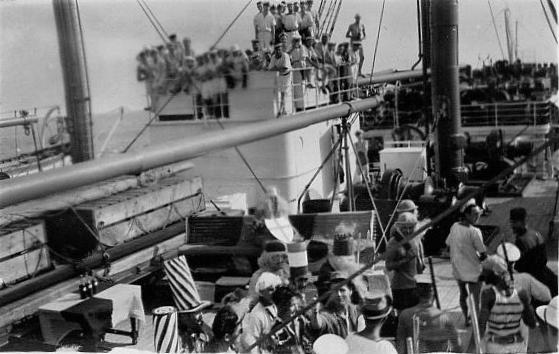
"Crossing the Line" ceremony February 17 1940 Photos by JF Aylard, survivor.

HMS Jervis
Bay at Dakar, Senegal, which has to have been taken in either January or
April, 1940. You can clearly see that the ship was not painted battleship grey,
as all of the painted pictures of the battle incorrectly indicate. You can also
clearly see the starboard guns. S2 (on the well deck) was blown off the ship
during the battle (complete with gun crew, who all perished - apart from Fred
Billinge, who was on deck elsewhere at the moment the salvo hit.) Photo by JF
Aylard, survivor.
 Commander Blackburn took temporary command of the ship in
February, 1940. It was under his command, that Jervis Bay undertook the
longest tow in WW2. Sent to rescue a stricken freighter (Hartismere) in
the South Atlantic, under the navigating skills of navigating officer George L.
Roe, it located the Hartismere (under temporary tow by the liner 'Queen
Of Bermuda'), and took over the tow on approximately 19 February, 1940.
It took ten days to tow the stricken freighter at sitting-duck speed back to
Freetown (mentioned in 'Conclusions of a Meeting of the War Cabinet held at 10 Downing
Street, S.W. 1, on Tuesday, February 20, 1940, at 11-30 A.M. , Page 71'),
earning the congratulations of the C-in-C for retrieving the disabled
freighter. The Hartismere would later be
attacked by U-100 in
August 1940, and sunk in July 1942, by the
Japanese submarine I-10.
Commander Blackburn took temporary command of the ship in
February, 1940. It was under his command, that Jervis Bay undertook the
longest tow in WW2. Sent to rescue a stricken freighter (Hartismere) in
the South Atlantic, under the navigating skills of navigating officer George L.
Roe, it located the Hartismere (under temporary tow by the liner 'Queen
Of Bermuda'), and took over the tow on approximately 19 February, 1940.
It took ten days to tow the stricken freighter at sitting-duck speed back to
Freetown (mentioned in 'Conclusions of a Meeting of the War Cabinet held at 10 Downing
Street, S.W. 1, on Tuesday, February 20, 1940, at 11-30 A.M. , Page 71'),
earning the congratulations of the C-in-C for retrieving the disabled
freighter. The Hartismere would later be
attacked by U-100 in
August 1940, and sunk in July 1942, by the
Japanese submarine I-10.
Jervis Bay remained on escort duties under the command of Blackburn
until April, 1940. On the 1st April, Captain Fogarty Fegen took command of the
Jervis Bay, and the ship sailed via Dakar (to pick up supplies once
again), and across the Atlantic to commence convoy escort duties based in
Hamilton, Bermuda (a British colony.). Jervis Bay was the first
'warship' to tie up in the historic Hamilton Harbour.
HMS Jervis Bay escorted
convoys from Bermuda to
Halifax, Nova Scotia, Canada. She escorted the convoys (BHX 041; BHX 044;
BHX 048; HX 051 - from Halifax itself; BHX 058;) from Bermuda, up until the
middle of July 1940.
 |
 |
Captain Fegen meeting the Earl Of Athlone and Princess Alice, Countess of Athlone during a visit to the Jervis Bay June 1940. Photos by JF Aylard, survivor. |
|
 In July 1940 she
sailed to Saint John, Bay Of Fundy, New Brunswick, Canada, where she was put in
to dry dock for 'degaussing', so that the
ship was not as easy to detect by 'U' boats.
In July 1940 she
sailed to Saint John, Bay Of Fundy, New Brunswick, Canada, where she was put in
to dry dock for 'degaussing', so that the
ship was not as easy to detect by 'U' boats.
This took about six weeks to complete, and the crew were based in Saint John.
They befriended locals, and some men returned to Britain to see loved ones on
'leave'. Their time in Saint John, like those in Bermuda, were the happiest
times, the crew were to comment. Some like Robert Squires (from Hull), would
meet Canadian sweethearts. HMS Jervis Bay left Saint John in early
September, 1940 to commence convoy escort duties based in Halifax, Nova Scotia.
More war service and the subsequent fate of the Jervis Bay is the focus
of this site.
 HMS
Jervis Bay in the dry dock at Saint John, NB, Canada. This is a unique
photograph, taken in either July or August, 1940. Photo by JF Aylard, survivor.
HMS
Jervis Bay in the dry dock at Saint John, NB, Canada. This is a unique
photograph, taken in either July or August, 1940. Photo by JF Aylard, survivor.
Morton Bay
 Moreton Bay, named for the large inlet near
Brisbane , was the first completed of all the 'Bays'. She entered service for
the Commonwealth Line when she departed London's Tilbury docks for Brisbane on
7 December 1921. She was followed into service within a month by the
Clyde-built Largs Bay.
Moreton Bay, named for the large inlet near
Brisbane , was the first completed of all the 'Bays'. She entered service for
the Commonwealth Line when she departed London's Tilbury docks for Brisbane on
7 December 1921. She was followed into service within a month by the
Clyde-built Largs Bay.
Moreton Bay was a most conventional ship in all respects. She
possessed the recent innovations of Vickers-built double-reduction-geared steam
turbines, which propelled her twin screws at a respectable speed of 15 knots.
Ports of call en route for Australia were similar to those of P&O - Port
Said, Aden and Colombo.
Upon the outbreak of WWII, Moreton Bay was
discharging cargo at Australia where she was hurriedly converted in a similar
fashion as outlined earlier with Jervis Bay. Moreton Bay experienced a
relatively uneventful war despite her thousands of miles patrolling the
Atlantic and later service as a troop transport. Her one great claim to fame
occurred on 31 October 1940 when she captured the "French liner Cuba
which had attempted to run the blockade outside harbour in order to get to a
Vichy
French port. After conversion into a 'trooper' Moreton Bay gave
sterling service on the North Atlantic route and the North African and Normandy
landings. During the
African invasion she
was damaged during an air raid while docking at Algiers. However the damage was
not of German origin. Moreton Bay had been abandoned in haste by her
tugs as the siren sounded, leaving her to crash heavily into the pier.
Moreton Bay returned to her owners following the war. After a refit
she journeyed in company with Largs Bay and Esperance Bay (2),
until April 1957 when she was sold to breakers at Barrow-in-Furness from where
she had first set out over 36 years earlier. Her name was awarded also to a
container ship of the Overseas Container Ltd consortium, the 26,876 tonner
Moreton Bay owned by the P&O Group. Although other vessels of the
O.C.L. fleet possess 'Bay' suffixed names none of these are derived from
vessels of the old Aberdeen & Commonwealth fleet.
Esperance Bay (1) (became Arawa (3))
 When, in 1933, the Kylsant shipping group was the subject
of a scandalous financial collapse, the operation of the 'Bays' was postponed
until some semblance of management could be established.
When, in 1933, the Kylsant shipping group was the subject
of a scandalous financial collapse, the operation of the 'Bays' was postponed
until some semblance of management could be established.
Throughout their careers to date the 'Bays' had scarcely had an opportunity
to prove their real worth owing to the unfortunate circumstances that seemingly
dogged them. It was with high hopes for the future that the newly reestablished
Aberdeen & Commonwealth Line Limited resumed business, albeit under the
control of the famous Shaw, Savill & Albion shipping line.
Shaw, Savill were also busy reorganising themselves, their services and
their fleet at this time. Their ageing although still most impressive Ionic
(2), a hand-down from White Star, was due for replacement after her
seventy-ninth round voyage to New Zealand. When she was sold to Japanese
ship-breakers in 1936 Shaw Savill transferred Esperance Bay to their own
fleet to replace her and she was accordingly renamed Arawa (3). She
subsequently served her new owners' trans-Panama route for another 19 years,
interrupted by war service as an armed merchant cruiser. The transferred ship's
name was awarded to Hobsons Bay... becoming Esperance Bay (2).
Hobsons Bay (became Esperance Bay (2) )
Esperance Bay (2) was also in Australian waters, bound for Brisbane on
that fateful day of the outbreak of WWII. Only the Clyde-built Largs Bay
remained in line voyage service after the declaration of war. Esperance Bay
(2) voyaged home via Cape Town, where additional armament was fitted,
before commencing her new role as an armed merchant cruiser.
Esperance Bay (2) served in this capacity until 1941, when she was
re-designated for employment as a troop transport. Her military career was not
uneventful. On one occasion she was attacked while at sea by German bombers. A
direct hit disabled her steering gear. However, she made port by clever use of
her twin screws.
Her early trooping duties took her mainly to and from the Middle East and
South Africa. On one voyage she was called upon to transport an entire garrison
to the South Atlantic Falkland Islands . Towards the end of the war she
transported large numbers of United States troops across the Atlantic.
Ironially the Nazi-controlled German radio claimed that she had been sunk at
least three times.
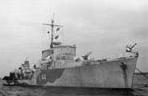 At one stage of her war
career Esperance Bay (2) was clad in a most novel form of camouflage.
Upon her dark grey flanks a white profile of a
'Hunt' class
destroyer was applied, a clever ploy devised to discourage enemy submarine
attacks.
At one stage of her war
career Esperance Bay (2) was clad in a most novel form of camouflage.
Upon her dark grey flanks a white profile of a
'Hunt' class
destroyer was applied, a clever ploy devised to discourage enemy submarine
attacks.
Esperance Bay (2) was sold for scrap in 1955, and demolished at the
Fasiane yards of Shipbreaking Industries Ltd, a subsidiary of British Steel
Corporation.
Largs Bay
 Largs Bay was actually on the last stages of her
homeward-bound voyage from Australia when war was declared on 3 September 1939.
Laden with passengers, general cargo and valuable foodstuffs, she cautiously
exited the Suez Canal and took a course which skirted the southern
Mediterranean coastline to Malta (because of England's concern regarding
Italy's loyalties to Germany and the possibility of attacks). After discharging
her cargo at Malta Largs Bay voyaged on to Britain and landed her
passengers.
Largs Bay was actually on the last stages of her
homeward-bound voyage from Australia when war was declared on 3 September 1939.
Laden with passengers, general cargo and valuable foodstuffs, she cautiously
exited the Suez Canal and took a course which skirted the southern
Mediterranean coastline to Malta (because of England's concern regarding
Italy's loyalties to Germany and the possibility of attacks). After discharging
her cargo at Malta Largs Bay voyaged on to Britain and landed her
passengers.
However she was not called up for war duties; instead she resumed commercial
sailings - in consort with other Shaw, Savill vessels, including the majestic
Dominion
Monarch. During August 1941, nearly two years later, Largs Bay
was requisitioned for Government use as a troop transport. In this capacity she
set out upon her first voyage to Singaporein convoy with many other liners so
converted. She was escorted by the Royal Navy's battleship
HMS Repulse,
later
tragically
lost
Largs Bay got away from Singapore before its invasion by Japanese
forces and returned to Britain. In January 1944, while entering Naples harbour,
Largs Bay struck a mine. The damage was repaired in time for her to take
part in the massive transatlantic trooping programme which preceded the Allied
invasion of Europe later that year.
Her trooping days came to an end in 1948 when she underwent a major refit
before returning to line voyages to Australia. Her superstructure, at main deck
level, was extended forward and aft - causing her to be greatly improved in
appearance and comfort for the newly reconfigurated, all Tourist class of 290
passengers.
Largs Bay continued in service upon the Southampton/ Brisbane route
until April 1957, when she was sent to the breakers at Barrow and joined her
Barrow-built sister Moreton Bay in demolition row.
Excerpt from
Ships
That Passed |


